Supplier Engagement

Setting clear expectations for suppliers

Supplier Engagement

Providing a baseline of action

The Climate Transition Coalition has developed new supplier sustainability targets to set clear expectations for suppliers across the sector. These targets are designed to accelerate decarbonization efforts and address Scope 3 emissions, which account for the majority of a company’s environmental impact.

These targets apply to suppliers who represent 60-80% of a company’s Scope 3 emissions, with a strong encouragement to cascade the expectations further down the supply chain to the suppliers of suppliers.

The targets provide a baseline of action for companies in the coalition, while encouraging members to go beyond these requirements where possible. Each company has the flexibility to implement the targets as they see fit and is urged to conduct their own materiality assessments to ensure the most relevant sustainability issues are addressed.

By aligning on these targets, we aim to drive sector-wide consistency and accelerate progress towards a more sustainable future.

Supplier Sustainability Targets
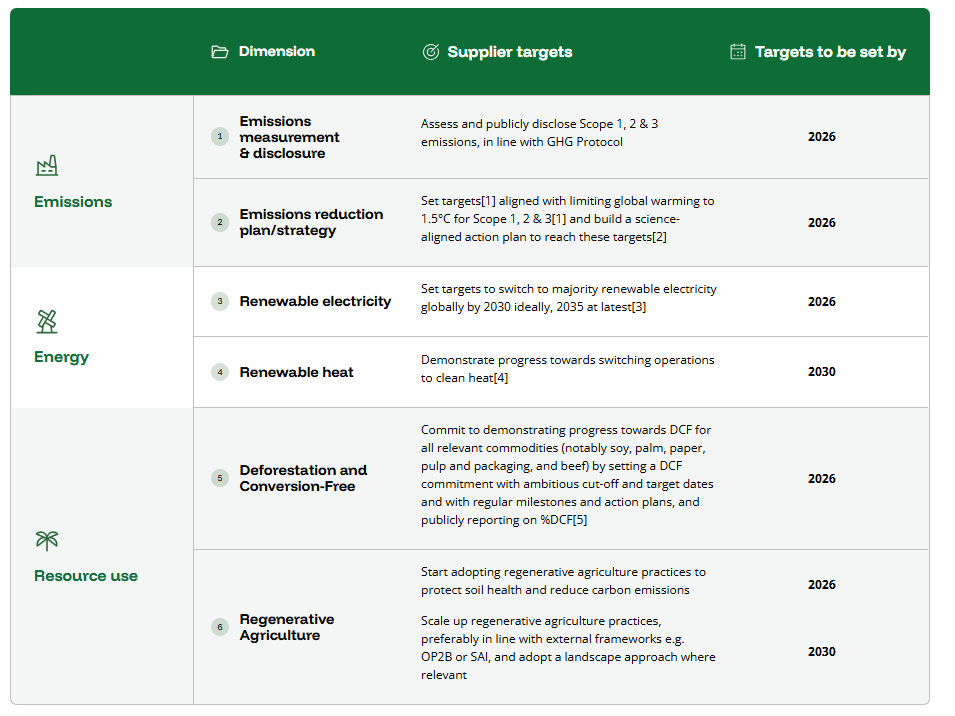
See below to click through to the key terms and resources associated with each dimension.

Emissions

Click through on the boxes below for key terms and resources

  • Emissions Measurement and Disclosure

    Supplier targets:

    Access and publicly disclose Scope 1, 2 & 3 emissions, in line with GHG Protocol

    Targets to be set by: 2026

  • Emissions Reduction Plan/Strategy

    Supplier targets:

    Set targets[1] aligned with limiting global warming to 1.5°C for Scope 1, 2 & 3[1] and build a science-aligned action plan to reach these targets[2]

    Targets to be set by: 2026

Energy

Click through on the boxes below for key terms and resources

Energy

  • Renewable Electricity

    Supplier targets:

    Set targets to switch to majority renewable electricity globally by 2030 ideally, 2035 at latest[3]

    Targets to be set by: 2026

  • Renewable Heat

    Target:

    Demonstrate progress towards switching operations to clean heat[4]

    Targets to be set by: 2030

Resource Use

Click through on the boxes below for key terms and resources

Resource Use

  • Deforestation and Conversion-Free

    Target:

    Commit to demonstrating progress towards DCF for all relevant commodities (notably soy, palm, paper, pulp and packaging, and beef) by setting a DCF commitment with ambitious cut-off and target dates and with regular milestones and action plans, and publicly reporting on %DCF[5]

    Targets to be set by: 2026

  • Regenerative Agriculture

    Target: Start adopting regenerative agriculture practices to protect soil health and reduce carbon emissions

    Year: 2026

    Target: Scale up regenerative agriculture practices, preferably in line with external frameworks e.g. OP2B or SAI, and adopt a landscape approach where relevant

    Year: 2030

Footnotes

1. Ideally near term and net zero 2. Recommendation to align with the frameworks and principles for transition plan as designed by ESRS/CSRD, Transition Plan Taskforce Framework and CDP, or other external frameworks depending on regional context 3. Leveraging guidance from RE100 or similar to support the transition 4. Clean is defined as zero carbon / carbon neutral technologies including but not limited to electrification heat technologies (e.g. heat pumps, e-boilers), biofuels (e.g. biomethane, biomass), other technologies (e.g. solar thermal, geothermal, Green hydrogen). Natural gas is not included. Heat includes both building and process heat emissions, and spans all possible temperature ranges 5. In alignment with the CGF FPC Commodity Roadmaps

Your Roadmap for Supplier Engagement

Your Roadmap for Supplier Engagement

Download these targets and additional resources to use within your organisation and share with your supplier network to ensure alignment across the value chain.

How to get started and engage with your suppliers

  • Using the targets

    These targets aim to provide a baseline of action across the coalition, but should not place a cap on ambition.

    Implementation is at the discretion of each company [1] and members are encouraged to conduct their own analyses to confirm topics' materiality.

    [2] Targeting suppliers* who represent 60-80% of your scope 3 *And your suppliers' suppliers (we encourage these targets to be cascaded).

  • Engaging with suppliers

    Involve all the right management groups (R&D, Sales, Supply, Strategy, Finance may be needed on top of procurement, CSR and the board).

    Be firm on your WHAT and WHY (you will need this in your reports, to auditors and financial institutions).

    Understand the supply chain complexity and that it won’t always be smooth sailing when setting targets.

  • Further tools and resources

    Click on each box on this page to access key terms and resources specific to each category.

    Take a look at the library of resources on our Decarbonisation Solutions Hub.

1. E.g. communication to suppliers, inclusion in code of conduct, etc. 2. Targets designed for suppliers representing 60-80% of company's supplier-driven scope 3 emissions

 Download the Supplier Decarbonisation Playbook

Download the Supplier Decarbonisation Playbook

A practical guide providing actionable steps for consumer goods companies to engage their suppliers and accelerate sector-wide decarbonisation

Our latest news

  1. Navigate green certifications in China with these practical guides

    Navigate green certifications in China with these practical guides

    See more
  2. Public consultation open: shape the future of regenerative agriculture in the consumer goods industry

    Public consultation open: shape the future of regenerative agriculture in the consumer goods industry

    See more