
 Search
  Search
 Marking a decade of progress, the 10th annual Sustainable Retail Summit (SRS) concluded today in Paris. This milestone forum gathered 250 industry leaders and experts from 100 companies and over 30 countries to shape the future of the sector. Ten years on, it is clear the conversation has evolved from shared ambitions to developing solutions at scale.
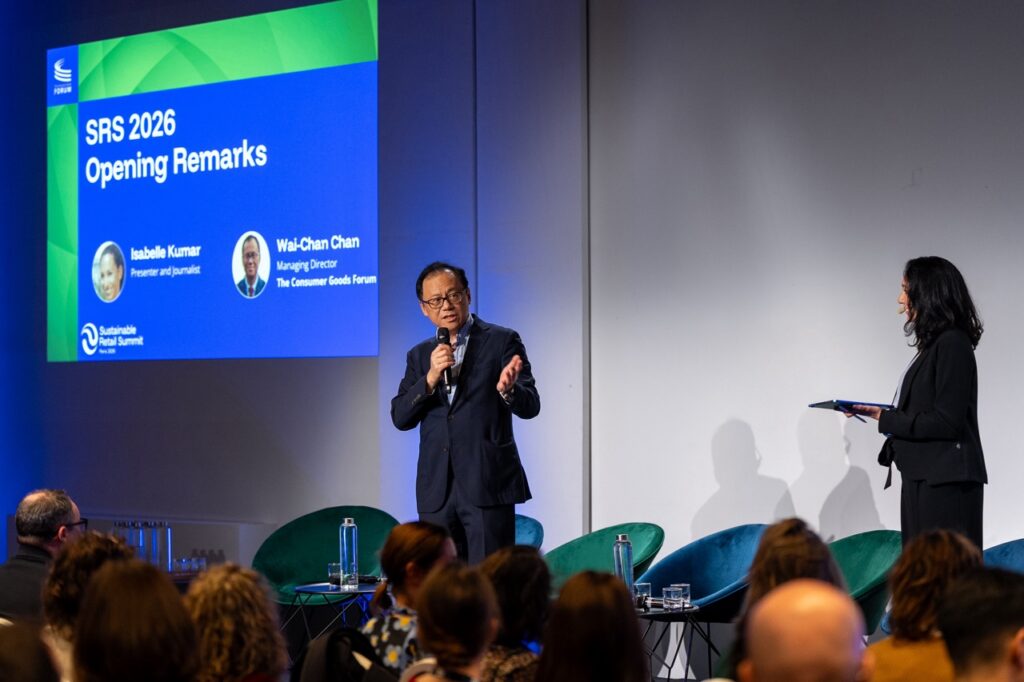
Wai-Chan Chan, Managing Director, The Consumer Goods Forum (CGF), set the stage by reminding delegates of the industry’s resolve to drive sustainability at scale, emphasising that collaboration is key to accelerating impact.
Discussions over the three days of the conference made one thing very clear: planetary health and corporate health are growingly intertwined. The following insights outline how collaborative ecosystems and responsible value chains reduce risk and create value for companies:
Climate as a strategic constraint & biodiversity as future-proofing asset

In their opening address, Bel Group CEO, Cécile Beliot-Zind and CEO of Tesco plc, and Co-Chair of The CGF Board, Ken Murphy, set the tone by positioning climate action and nature protection as integral to long-term business resilience.
Putting this principle into practice, with sessions explored how decarbonisation, biodiversity and circularity are now embedded into sourcing and investment decisions to de-risk supply chains.
“The name of the game is to make sustainability sustainable by making it part of the fabric of the business.” – Antoine de Saint-Affrique, CEO, Danone
Scalable, sharable solutions for waste management were featured, such as The Reuse City Project in Ottawa, Canada where they are testing pre-filled, returnable packaging across multiple major brands.
“We’ve invested billions to make single‑use packaging cheap and easy. Now we need to invest to make circular systems just as easy – for businesses and for consumers.” – Stuart Chidley, Co-Founder of the Beauty Kitchen and Reposit
Collaboration as a governance and execution imperative
 A recurring theme, collaboration, emerged as a critical capability to address system-level challenges. Leaders underscored the value of pre-competitive partnerships to accelerate learning, align standards and scale impact.
“If we don’t fix the system, there is no packaging design in the world that will fix circularity. We have to share good practices, and develop circular systems all over the world.” – Katarzyna Grzybowska, Nestlé
Responsible value chains as enterprise risk management
 Responsible sourcing, human rights and ethical practices were identified as core elements of risk management. With rising expectations on due diligence, transparency and accountability, organisations are strengthening supplier engagement to improve predictability, resilience and trust throughout their network.
Royal Swinkels demonstrated the power of value chain redesign, achieving a 57% CO₂ emissions reduction through a holistic decarbonisation strategy, including clean energy, heat and water reuse, transport optimisation, and returnable packaging.
“Our Circularity Index is quite unique. We built this framework to try and set an example for manufacturing companies and the CPG industry.” – Peer Swinkels, CEO, Royal Swinkels
Data & AI as a force to optimise and innovate
 Technology featured prominently as both an enabler of operational efficiencies and a catalyst for innovation.
Carrefour illustrated the power of data-driven retail, achieving +9% forecasting accuracy thanks to real-time inventory, hence reducing food waste.
“Addressing food waste is very important for Carrefour. We see a big advantage with AI in forecasting, which is crucial if you want to reduce food waste.” – Carine Kraus, Director Executive Engagement, Carrefour
Addressing the 242 millions of annual retail food waste, Vusion demonstrated how computer vision, specifically instant inventory for kiosks, is providing the industry with the visibility needed to eliminate waste.
Bain & Company highlighted the dual-value of AI-driven packaging, noting that generative design cut R&D costs by around 20% while streamlining data and reporting requirements across the value chain.
Food systems as a strategic growth and trust agenda
 Delegates explored food systems through the lens of resilience, trust and future growth. With resource scarcity, farmer livelihoods and affordability top of mind, discussions highlighted the need for long-term, collaborative planning.
“As sustainability leaders, are we building resilience, or just addressing risk?” – Harry Morrison, Bain & Company
In a panel called ‘Securing the Shelf Starts in the Soil’, 2050NOW La Maison and Quantis showed how regenerative farming builds supply resilience – with data showing steadier yields and up to 15% higher protein content.
The sessions looked closely at the role of manufacturers and retailers in guiding consumer choice and the need to work together to support farmers and sustain trusted food systems.
“We need to create the farming of tomorrow, that is both economically viable, especially for farmers, while safeguarding planetary resources.” – Cécile Beliot-Zind, CEO, Bel Group
===
SRS reflected a sector moving from innovation to impact at scale, with leaders embedding sustainability into strategy, strengthening collaboration, and leveraging data and technology to deliver tangible value for people, the planet and the businesses they lead, under the convening role of The CGF.
Building on this momentum, we look forward to continuing the conversation and sharing progress at our next flagship Global Summit in Vienna in June 2026, where industry leaders will gather around four strategic themes: The Evolving Consumer, AI and Tech Applied, People & Planet, and Influencers and Makers.
An ambitious agenda for an ambitious future! You can already sign-up here.
===
We would like to express our appreciation to all our sponsors for their invaluable contribution to this year’s SRS. Special thanks to Bain & Company (Exclusive Partner) and Vusion (Premium Sponsor); The Coca-Cola Company, Danone, PepsiCo, 2050Now La Maison, PEFC, and the Sustainable Forestry Initiative (Sponsors); Mérieux NutriSciences, Reposit, and Renova (Exhibitors); and our media partner, 2050Now La Maison (Media Partner).
