
 Search
  Search
 Consumers tell us they care about sustainability and have a true desire to live more sustainably. Yet why do so many people struggle to make that intent a reality? And why has reported concern about sustainability slipped a bit this year? We actively listen to consumers around the world through Bain’s Global Consumer Lab to keep our pulse on attitudes and behaviours. And our latest shows us the answer to these questions: it’s friction—not indifference.
An overly complicated landscape for consumers
When I speak to leadership teams at Consumer Products companies and Retailers, they often react a bit dubiously when I tell them that consumers care. And perhaps for good reason: they don’t see their sustainably-marketed products flying off the shelf. But let’s put ourselves in the shoes of the shopper or the consumer. Just walk down the toilet paper aisle at the supermarket to bring this to life. Do I choose the one made from recycled paper? The one that is sustainably harvested? The bamboo paper? The biodegradable option? The plastic-free packaging? The one that claims zero deforestation? And remind me why I’m paying over two times the price of the one without all those claims? (Now you get it).
I caution against ‘blaming’ the consumer for their ‘say-do’ gap. Businesses are not making it easy for them. Whether it’s price premiums beyond willingness to pay, lack of clarity on what’s truly sustainable, limited availability, or confusing claims and labels, there are plenty of reasons consumers aren’t choosing the sustainable option.

About eighty percent of consumers globally are concerned about sustainability, and 70% of consumers want to adopt more sustainable behaviours, yet barriers remain that business leaders have the ability, and responsibility, to remove.
Why what’s happening this year matters
We’ve seen two consumer shifts this year that are particularly important for companies trying to serve consumers sustainably.
Consumers are overwhelmed – let’s not add to it
First, consumers are overwhelmed. They’re navigating a cost-of-living crisis, geopolitical instability, and a sense of mental overload. Against that backdrop, it’s not surprising that reported concern about sustainability has dipped slightly.
As consumers feel stretched, they are leaning into on-demand convenience as a coping mechanism. They are actively looking for ways to reduce friction, effort, and decision fatigue. For example, consumers tell us they want to cut back on food delivery, yet spending in this category continues to grow.
In this context, consumers don’t want shopping to feel like work, nor do they want to make difficult trade-offs between price, performance and sustainability. If the next wave of sustainable innovation still asks consumers to compromise, adoption will stall. The opportunity for companies is to design products and experiences that remove those trade-offs altogether, making the sustainable choice the easy, obvious one.
AI: closing the knowledge gap and disrupting the shopping funnel
The second shift is technological. GenAI has moved from a novelty to a daily utility. In our Bain Consumer Lab research, nearly 70% of US consumers have used GenAI, and roughly 40–45% now use it daily—up sharply in just nine months. Consumers trust these tools because they help with learning, comparison, and decision support, which naturally extends into shopping.
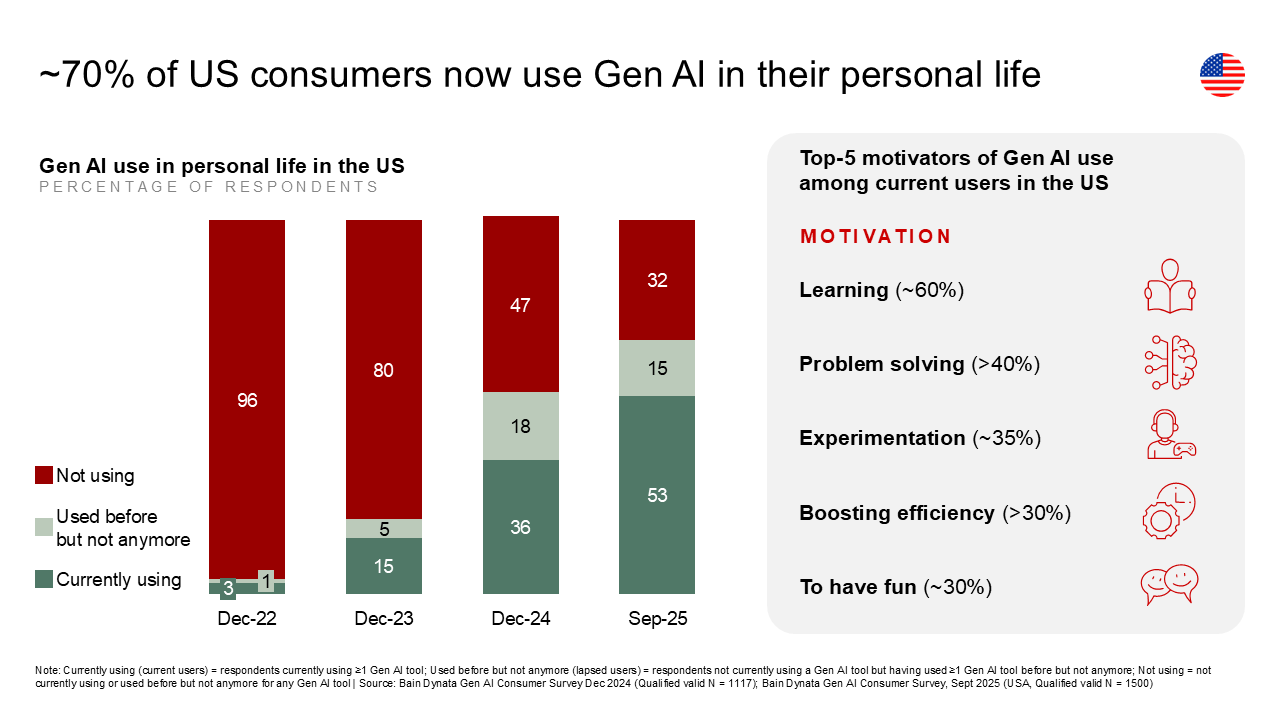
This matters because the consumer knowledge gap has long been a large barrier to sustainable consumption. AI has the potential to close that gap. Instead of standing in the aforementioned toilet paper aisle trying to decode claims, consumers can ask AI “what’s the most sustainable option for me?” and get a clear, personalised answer.
In that world, brands with accurate, transparent, and accessible product data are far more likely to earn both consumer trust and algorithmic visibility. But data alone won’t be enough. The product still has to perform, be accessible (both physically and affordably), and resonate. If consumers are talking about your product, AI will surface it. If they aren’t, it won’t.
Now what
The path to more sustainable consumption won’t be driven by guilt or asking consumers to try harder. It will be driven by better design—of products, of pricing, of information, and, of the digital systems that will increasingly guide everyday consumer decisions. Sustainability will scale not when consumers care more, but when companies make it easier for them to act on the care they already have.

