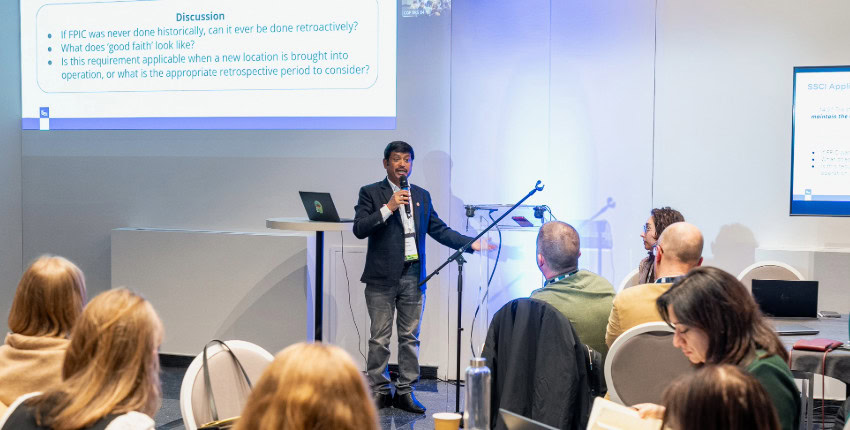
Ahead of The Consumer Goods Forum’s (CGF) Sustainable Retail Summit, our Human Rights Coalition (HRC) and Sustainable Supply Chain Initiative (SSCI) convened a stakeholder engagement workshop at the New Cap Event Center on 3 February 2026. The session brought together 35 stakeholder organisations to share learning and build a deeper understanding of the complex challenges related to Indigenous Peoples and Local Communities (IP&LCs) and their land rights within global supply chains.
The workshop provided a forum to explore best practices and support industry-wide understanding of human rights due diligence. Participants focused on the practical application of Free, Prior, and Informed Consent (FPIC), the protection of High Conservation Value (HCV) areas, and how businesses and sustainable standards can work together to have a positive impact.
“Indigenous communities are not stakeholders — they are rights holders. FPIC is not a consultation exercise, but a decision-making process that must be respected from the outset.” — Yogendra Chaudhry, ECO Canada and SSCI Benchmark Leader
Bridging the Implementation Gap through Shared Learning
The session explored how SSCI defines high-level criteria that can help schemes and suppliers independently mitigate risks. Participants identified opportunities to translate broad goals into implementation, helping to ensure that community land rights are meaningfully upheld across value chains through independent company action.
FPIC and the Role of Auditing
A major focus of the dialogue was the limitation of current audit processes for primary production sites, such as farms. Stakeholders shared insights on the potential for more approaches that may fully capture broader social impacts that extend beyond individual company premises.
Navigating Operational Complexities
Expert input highlighted the practical challenges in implementing Indigenous rights, including varying legal requirements and the complexities of engaging directly with communities. The workshop examined the difficulties auditors face in effectively verifying compliance with these requirements.
Exploring Solutions through Real-World Insights
To ground the discussion, participants engaged in pre-competitive research and shared insights from the Shared Social Grievances working group with the Forest Positive Coalition. These examples helped identify current gaps in practice and provided a basis for exploring voluntary approaches to strengthen respect for IP&LCs and defenders rights.
“By aligning standards, auditing, and company practice, we can move from intention to implementation and ensure FPIC and community land rights are meaningfully upheld across global supply chains.” — Maria Isabel Cubides Sanchez, Senior Manager, Social Sustainability, The Consumer Goods Forum
Working Together for Future Progress
The workshop concluded with a focus on continuing the dialogue to identify further opportunities for shared learning and capability-building. Through expert input and further development of best practices, The CGF continues to support industry in efforts to respect the rights of IP&LCs and human rights defenders in value chains.
To learn more about the Sustainable Supply Chain Initiative or the Human Rights Coalition, please contact
.