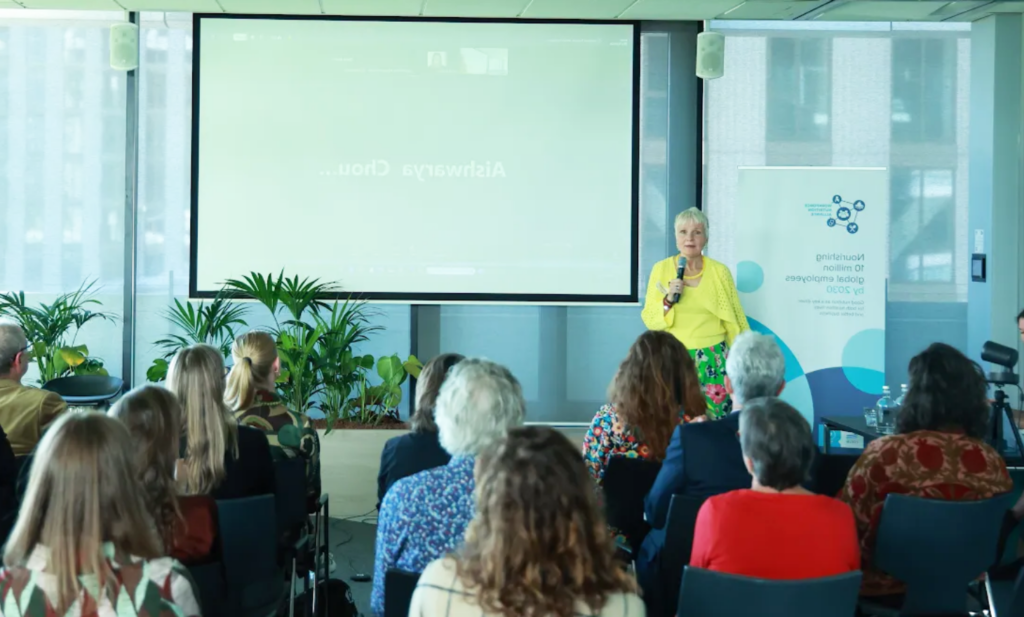
The CGF joins global partners in The Hague to advance workforce nutrition
On 21 April 2026, Sharon Bligh, Director of Health and Sustainability at The Consumer Goods Forum (CGF), joined the Global Alliance for Improved Nutrition (GAIN) to co-host the roundtable “Building Resilient Businesses Through Workforce Nutrition” in The Hague. Speakers and contributors included representatives from the CGF, GAIN, the International Labour Organization (ILO), the Dutch Ministry of Foreign Affairs, Ajinomoto, JDE Peet’s, ofi, Nudge to Nourish, the Access to Nutrition Initiative (ATNI), and the World Benchmarking Alliance (WBA).
The discussion brought together more than 40 public and private sector leaders to reflect on progress, share insights, and identify the next steps to scale nutrition impact across global supply chains.
Strengthening workforce nutrition efforts
The WNA has made significant strides in embedding nutrition into business practices. Since 2019, the initiative has reached 6.7 million workers, more than double its initial 2025 target, with a renewed ambition to impact 10 million people by 2030.
As highlighted during the Symposium, workforce nutrition is increasingly recognised not only as a health priority, but also as a critical driver of productivity, resilience, and sustainable business growth. Evidence shared during the session showed that employees with poor nutrition are significantly more likely to experience reduced productivity, with research highlighted by WNA indicating that workforce nutrition programmes can be associated with up to 25–30% reductions in sick leave and improved productivity outcomes, reinforcing the strong business case for action.
From workplace health to holistic wellbeing
A key theme of the roundtable was the growing momentum to integrate nutrition into Occupational Safety and Health (OSH) frameworks. Joaquim Nunes, Branch Chief, Occupational Safety and Health at the ILO emphasised that workers’ health is shaped not only by workplace risks, but also by everyday factors such as access to safe and nutritious food.
This reflects an important evolution in Occupational Safety and Health thinking, moving beyond a sole focus on workplace hazards to a more preventive, holistic approach to employee wellbeing. Participants also noted that workplace practices such as meal provision, canteen services, and employee benefits offer practical entry points to support better nutrition outcomes.
Scaling across supply chains
Participants also explored how workforce nutrition programmes are expanding beyond corporate offices into global supply chains, reaching factory workers and smallholder farmers alike. Companies such as Ajinomoto, JDE Peet’s and OFI shared their commitments to scale interventions, recognising the link between nutrition, supply reliability, and long-term resilience.
The symposium underscored that addressing nutrition challenges in agricultural communities, where long hours, physically demanding work, and limited access to diverse food are common, can have far-reaching positive impacts on productivity and livelihoods.
To support this, the WNA recently launched a new series of Workforce Nutrition Guidebooks and a self-assessment scorecard for smallholder farmers, offering practical, step-by-step guidance across four pillars: access to healthy food, nutrition education, health checks, and breastfeeding support.
Strengthening collaboration for lasting change
Looking ahead, discussions focused on strengthening public-private collaboration, making better use of digital tools to track nutrition outcomes, and continuing efforts to embed nutrition more firmly into global labour standards.
The Symposium also reinforced the need to integrate workforce nutrition more systematically into business operations and supply chains. For the CGF, this remains a clear priority, as companies work to turn commitments into practical action that supports employee health and wellbeing, healthier and more resilient workforces.